March 27, 2026, the Future Farmers of America (FFA) chapter participated in the horse judging evaluation competition, Career and Leadership development Event (CDE) with the American Quarter Horses Association, or the AQA, at the Conyers International Horse Park. The senior team, ranked 21st out of 50 teams for their first time competing after the results came out.
A quarter horse is a horse that can run a quarter mile the fastest because of the muscling in the back leg. With this, choosing the right horse for a specific task allows both the horse and the rider to stay safe and for the activity done to be at its highest level.
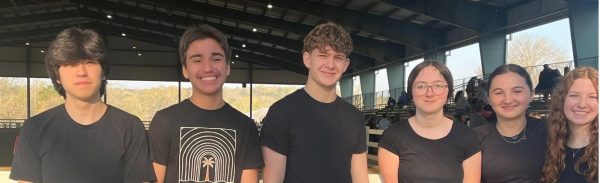
From left to right: Joseph Huggins, Aidan Inzina, Carson Sewell, Scarlett Moeller, Aine Mullis, Samantha Epstein.
Ms. Allison Bridges is an agriculture teacher at Wheeler, serving her second year at the school. When it comes to competitions or CDEs, she always makes them student-based: “There are thirty-five plus competitions we can choose from, and based on what our students would like to try, we work on it with them. Basically it is the choice of students, and I try my best to teach the content to the best of my ability because any ideas they are willing to try, then we are willing to try with them.”
In this case horse judging evaluation this year was also the first ever for students, and a lot of students may or may not have seen these horses in real life or have seen competitions like this before this: “Whenever we were training, a lot of videos were involved, due to the fact that it is hard to get a bus to see and apply what they learnt in real life. But I think we did really well by seeing the videos, and weeks before the competition they stayed everyday after school except Fridays and worked very hard for it.”
With competitions, it was not only students or teachers studying; it was a collective experience as long as students are willing to put in the work.Through this competition, students are able to work on their teamwork, with the senior competition especially: “As they are able to work on the team activity together, as well as practicing public speaking and critical thinking.”
When it comes to public speaking, students were expected to give two sets of verbal reasons to a judge. They have to be able to practice combining words and vocab and be able to explain the why behind everything: “Learning the why behind everything, can make a student have an overall better understanding of any concept.”
Balancing would mean building confidence: ”Practicing out loud and listening to others helped build the confidence of the students especially with it being our first year to make sure they have nothing to lose from this experience.”
Competitors giving reasons to judges.
The excitement and seeing how happy students are participating in and trying new stuff. “Witnessing a student coming out of their shell grow and growing, is rewarding because it encourages them to come out and try the waters and make the decision to either like something or not, all being okay because if you truly give everything a chance, you would truly know what your favourite is.”
Challenges were a lot because they were teachers who had more experience, students who grew up around animal science, and with this being the first animal science program here and in an urban area overcoming was difficult but students were motivated to still try. With FFA, their biggest thing is inspiring premium leaders, as in “Students who can really explain the world around them and work through situations.
Carson Sewell (11) shared that for someone to get into horse judging and enjoy it, he or she would recommend people to put in the hours, focus on what breeds there are, and the tools one needs to identify the horses. He also mentioned, “Memorizing the tag that is involved, the equipment needed and stuff to be important.”
During the competition, he made bullet points and tried to as he said, “Speak it out in my mind but the main thing is the bullet points and understand what horse did this good or bad and add all those would compare and contrast the horses to come with a ranking.”
His favorite part was seeing the horses coming around by their handlers and getting that on hand experience. He said, “It is mainly an individual competition but if a team can work together to study with or without the teacher is when the team actuary comes together and far far a team can go in the tournament, because in most teams one or two people would do good and then the rest would not do as well, which causes the overall position of the team to fall.”
He advised for students who had not been exploring any clubs and were looking for something to get into, he recommend joining FFA and doing CDEs like for example during horse judging, it was allowed for people to go around and pet the horses, tour the area, meet the owners of the horses and basically build a community.
He admitted, “My biggest challenge was preparing the reasons, because until you really get there and the performances are done, you do not really know what exactly to say. You are going to have to memorize around 150 years but overcome this by getting the general structure of the reasons.” In Carson’s case, he had a general idea on how things were going to be or just the landscape and the things that he did not know, he just adapted.
Joseph Huggins (10) was on the senior team and encourages students to try if they are interested in horses. He said, “ You get to miss a day of school, it is pretty fun, and you get to experience what you were learning prior weeks in real life.” He got on the team at the last minute, with about a week to study, but with the info and resources Ms Bridges gave, quizzlets and watching videos about horse judging, reviewed lots of the id. “I watched videos of horses that do shows where judges score them but then I compare my answers with them.”
He also mentioned staying as a group after school also helped ground him and prepare. “I really enjoyed looking at the performances the horses put on. In horse judging there were around three performances and two where we had to observe the horse breeds, also the confirmation.” He describes the first three performances where the horses walked around the stage which was entertaining to watch because one could clearly see the differences between a well trained, well mannered horse to a less trained one. They had to rank them in order of breeds and judge the horses.
Joseph Huggins (Competitor senior team)
They got the chance to also stand close to the horses and compare and see what an ideal horse was supposed to look like. With FFA, “ The competitions are promoted as a team event, but it’s not always like that even though once a score is determined by your team. With horse judging, you take a test on your own, you judge the horse on your own, rank them on your own, and you speak to the judges on your own except the team activity which is not worth the bigger score.” Meaning that the team building happens before the competition where they share their resources and study together in hopes that at the completion students would be able to score individually with the team in mind.
From the competition, Joseph shared that, “I now appreciate horsemanship more, because I low key had the idea that horses are just horses but it’s deeper than that. It is not just any horse that does shows or a specific activity, it is looking at how the horse walks, how a rider treats the horse, how responsive the horse is, what his trots are like, and many more that go into consideration when horse judging.”
For future students, he would advise to watch just general knowledge about horses because there was a question about what legumes horses ate that he did not review, also knowing the format to avoid fluster and actually reviewing the parts of a horse so the reasons to the judges can flow better.
He said, “ My biggest challenge was watching the performances in real life and judging them, then telling or communicating his notes to the judges. I honestly just winged it because my terminologies were a little off but had a straight face and said what I gathered with confidence. I also wrote it down as much as I could to memorize my reasons. I would not do it again but if no one is interested I would because in all it would be another fun experience. I would still recommend it because you can still learn new stuff.”Western Pleasure Performance.
Scarlett Moeller (9) joined the junior team which consists of only freshmen. She said, “I joined the competition because it seemed really interesting plus, I had taken care and rode horses before the competition.” Something that surprised her was that there were many factors to judging a horse. It is not just looking at the horse and choosing the one someone likes at that moment.
She said, “It was hard to remember the reasons I wanted to say, because I would forget as soon as it was my turn.” The practice session consisted of, “Learning new things or information from my binder given by Ms. Bridges, Ms. Bridges playing videos of horses or we just answered questions or did practices.” She shared how because of horse judging, “I know when a horse is muscled well.” She mentioned her hardest part was memorizing her answers to speak in front of judges, but she kept in mind that since it was her first, “My goal was to do the best I could and not get last place.” She would recommend to people who have a joy for learning about or to learn about horses or some knowledge about horses.
Categories:
First Horse Evaluation Competition
June 11, 2026
More to Discover

About the Contributor
Edelina Amihere, Editor-in-Chief
Edelina is a junior and this is her third year writing for the Catalyst. She plans to go to a prestigious university and major in pre-law. In her free time she likes to read, listen to k-pop, and watch movies in foreign languages.